
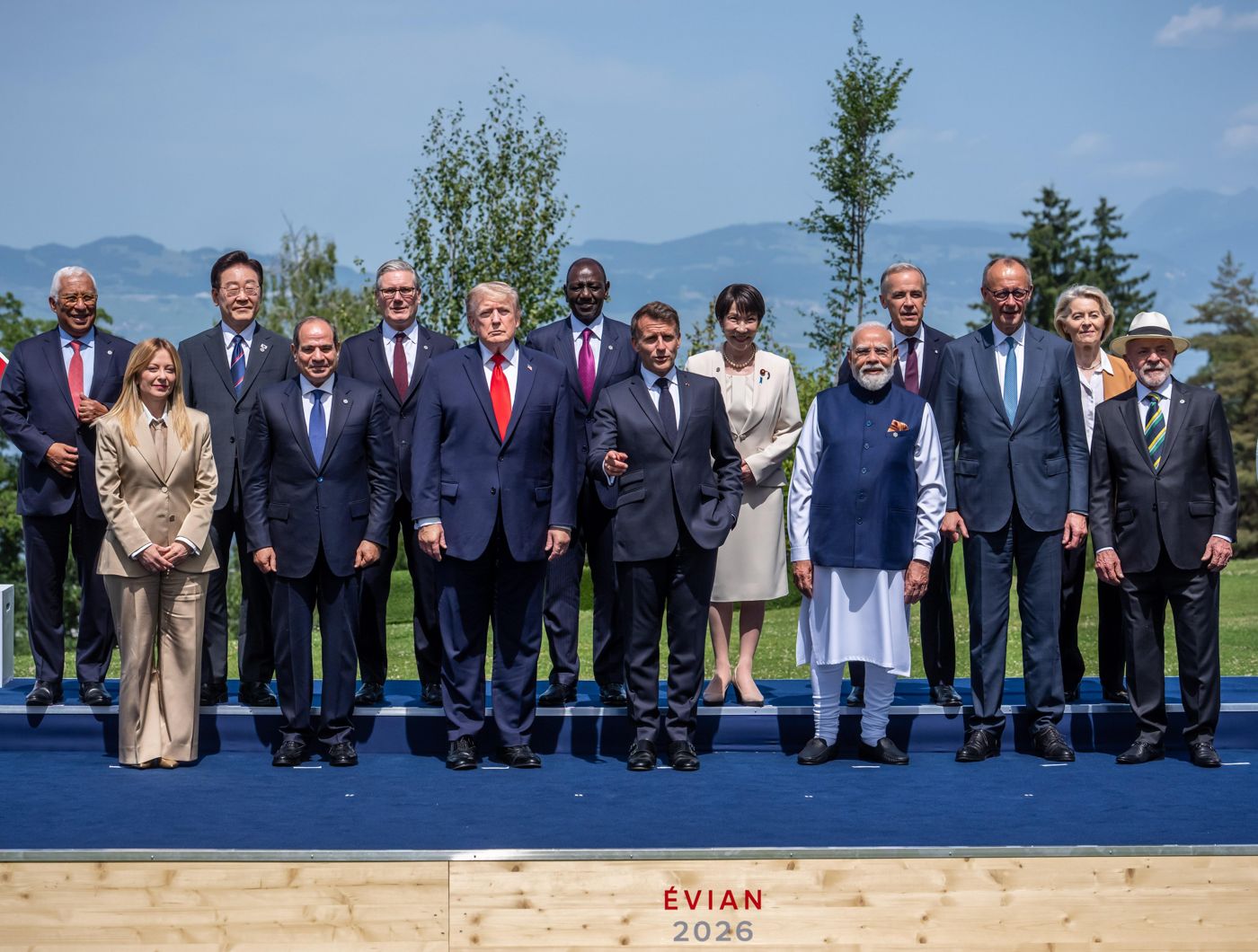
Donald Trump, Emmanuel Macron, Friedrich Merz and other world leaders gathered in France for critical discussions about the global economy, international security and the technologies that could transform the next decade.
Évian-les-Bains, France — November 3, 2026 The world's most influential industrial democracies gathered in France for a summit that revealed how dramatically international politics and the global economy are changing. From June 15 to 17, 2026, the picturesque town of Évian-les-Bains became the center of international diplomacy. The leaders of the Group of Seven met to discuss economic instability, international conflicts, artificial intelligence, critical minerals and the future of global cooperation. Among the participants were US President Donald Trump, French President Emmanuel Macron, German Chancellor Friedrich Merz, British Prime Minister Keir Starmer, Italian Prime Minister Giorgia Meloni and Canadian Prime Minister Mark Carney. Japan also participated, alongside representatives of the European Union. The discussions took place against a backdrop of geopolitical tensions and growing uncertainty about international trade. The central question was whether the world's major economies could find common ground despite their increasingly different political and economic priorities. The summit produced nine joint declarations, demonstrating agreement on several important issues. However, the decisions also highlighted the scale of the challenges that remain unresolved.
A Summit Held at a Critical Moment
France hosted the 2026 G7 summit under President Emmanuel Macron's leadership. The French presidency emphasized cooperation and practical solutions to international challenges. Unlike a summit focused exclusively on trade and finance, the discussions covered a wide range of political, technological and security issues. The gathering also included representatives from important partner countries. India, Brazil, South Korea, Egypt and Kenya were invited to participate in discussions, reflecting the importance of cooperation beyond the traditional G7 membership. The decision demonstrated an increasingly important reality. Major economic and geopolitical challenges cannot always be addressed by the world's wealthiest democracies acting alone. Emerging economies now play central roles in global manufacturing, energy demand, technology and international trade. Donald Trump and the Future of US–Europe Relations One of the most closely watched figures at the summit was Donald Trump. His administration's approach to international trade has generated substantial debate among European governments. Tariffs, industrial competitiveness and the future of economic cooperation remain significant concerns. The United States and European Union maintain an extensive trading relationship. European manufacturers export vehicles, machinery, pharmaceuticals and other products to American markets. American companies depend on European customers, suppliers and investment. Changes in trade policy can therefore affect businesses on both sides of the Atlantic. At the summit, leaders discussed the need for more balanced and resilient economic growth. Their joint statement recognized the importance of avoiding future trade conflicts and strengthening international economic cooperation. However, the document did not resolve every outstanding disagreement between Washington and European capitals. The challenge remains finding policies that support national economic interests without triggering damaging international trade disputes.
Emmanuel Macron Pushes for Greater Global Cooperation
As host, Emmanuel Macron sought to demonstrate that international cooperation remains possible despite geopolitical divisions. The French presidency placed particular emphasis on reducing global economic imbalances. These imbalances can emerge when countries experience persistent differences in trade, investment, production and consumption. Such conditions may contribute to political tensions and financial instability. France also emphasized the importance of involving developing and emerging economies in international discussions. For Macron, the summit provided an opportunity to promote a wider approach to global governance. The participation of India, Kenya, Egypt, Brazil and South Korea reflected that ambition. The French presidency presented the summit as an important step toward more inclusive international cooperation.
Friedrich Merz and Germany's Economic Priorities
German Chancellor Friedrich Merz participated at a time when Germany faced significant economic challenges. Europe's largest economy is under pressure to strengthen manufacturing competitiveness and modernize its technological infrastructure. German industries depend heavily on international trade and reliable supply chains. Automotive production, machinery and chemicals remain important sectors. At the same time, companies are investing in artificial intelligence, automation and advanced manufacturing technologies. For Germany, cooperation with international partners is essential. The G7 discussions about global growth and critical minerals were particularly relevant to these industrial priorities. Access to essential materials is becoming increasingly important as countries expand their semiconductor, battery and renewable-energy industries.
Ukraine Remains a Central International Concern
The war in Ukraine was one of the summit's major geopolitical priorities. Ukrainian President Volodymyr Zelensky participated in discussions with G7 leaders. In their joint statement, the leaders reaffirmed support for Ukraine's sovereignty and territorial integrity. They also committed to increasing assistance for Ukrainian defense capabilities. The declaration referred to additional air-defense systems, interceptors and long-range capabilities. Energy resilience was another important issue. Ukraine's infrastructure has faced repeated attacks, creating serious challenges for electricity supply and essential services. The G7 leaders also committed to increasing pressure on Russia's war economy.
Although the statement demonstrated broad agreement,